



Sometime in the next few months, a new hire is going to hand a Texas bar manager a seller/server certificate that looks nothing like the ones already in the personnel binder. It is probably fine. The Texas Alcoholic Beverage Commission changed the design.
TABC announced the redesigned certificate on September 25, 2026. According to the agency, the certificate issued to bartenders, cashiers and servers who complete an approved seller/server course was reworked in August 2026 to align with the agency's branding standards. A cosmetic update, in other words. The announcement did not mention any change to the training itself or to how long a certification lasts.
Your current certificate is still good
TABC was direct on this point: the design change does not impact the validity of current seller/server certifications. Nobody has to retake a class or ask for a reprint because their paper has the old layout.
The agency also said training schools may still issue certificates in the older design while they make the switch. So for a while both versions will be in circulation, and a certificate earned this fall could arrive in either style.
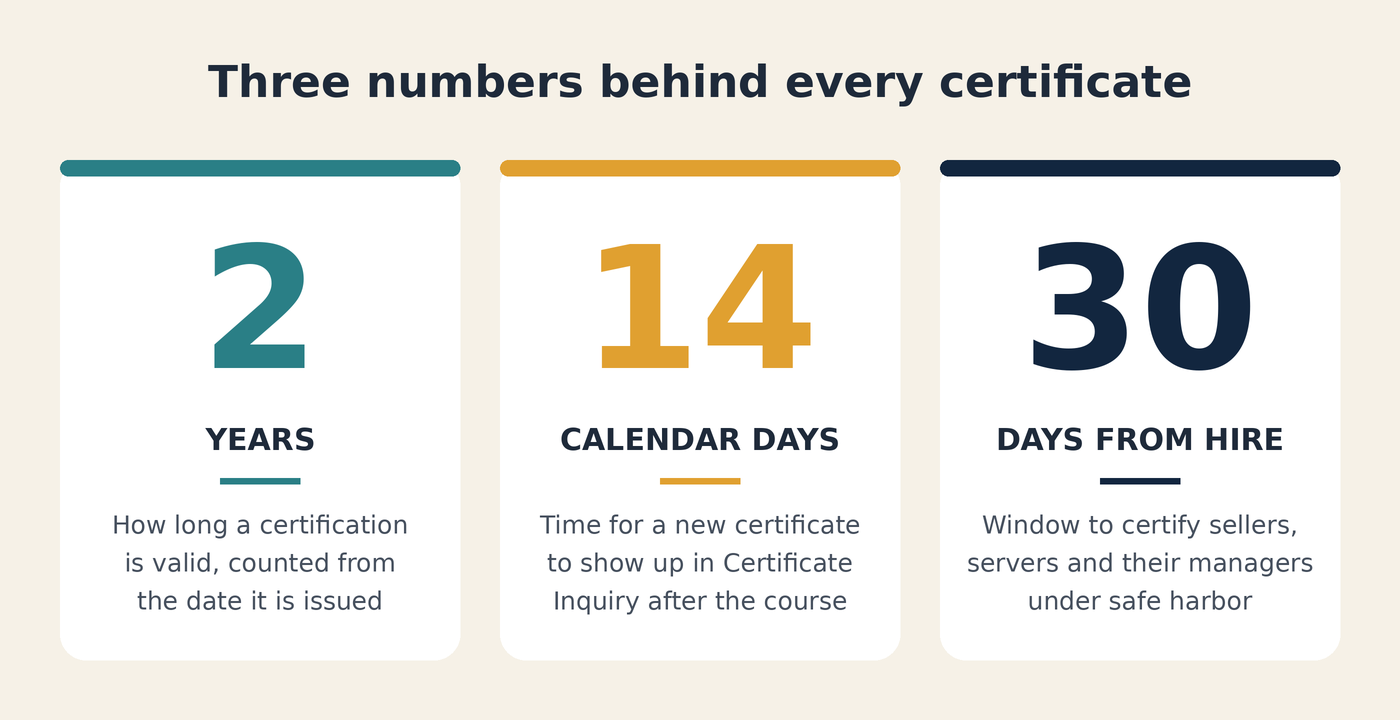
The clock has not moved either. A certification is valid for two years from the date it is issued, and renewing means taking the training again once it expires.
The paper was never the proof
A redesign is a good excuse to look again at how certification gets verified, because a printed certificate is only a copy of a record TABC keeps. That record sits in the agency's Certificate Inquiry system, which TABC describes as official proof of seller/server certification in Texas. In the redesign notice, the agency told employers and employees alike to check that system to verify a certification's status.
A lookup asks for the person's name, Social Security number (typed without dashes) and date of birth. The result can be printed, and according to TABC's certification FAQs the printout shows the issue date, expiration date, certificate number, status, name and date of birth. That is more than most managers ever read off a wallet card. And when the manager runs the lookup personally, there is nothing for a photo editor to touch.
Which matters, because fake certificates exist. TABC states that counterfeit and forged seller training certificates are a criminal offense, with punishment ranging from a Class A misdemeanor to a state jail felony. With two legitimate layouts in circulation, judging a certificate by its looks gets harder. Looking it up settles the question.
The 14-day gap that trips up new hires
One wrinkle catches people every hiring season: finishing the course and showing up in the state database are two separate events. TABC's FAQ says an employee's certificate will be available in the inquiry system 14 calendar days after the course is completed. A server who passed the class on Monday can come up empty on Tuesday without anything being wrong.
If the record still has not appeared after 14 days, the FAQ gives 512-206-3420 as the TABC number to call. Until then, the certificate from the school is what the employee has to show, old design or new. Managers who verify at hire may want a calendar reminder to run the lookup again two weeks later and file the printout.
Why managers track certification so closely
Texas does not require bartenders or wait staff to be certified. TABC says so plainly in its FAQ, then adds that many employers require certification anyway. The reason is a protection usually called safe harbor. When an employee sells or serves alcohol to a minor or an intoxicated person, the employer has some protection from that violation if certain standards are met. TABC notes that it does not apply to alcohol sales to members of private clubs.
The standards, as TABC lists them:
- The person who made the sale is not the owner or an officer of the company.
- The person who made the sale holds a current seller/server training certificate from a TABC-approved school.
- All employees engaged in the sale, service or delivery of alcoholic beverages, along with their immediate managers, are certified within 30 days of their hire date.
- The employer has written policies for responsible alcohol service and makes sure each employee has read and understands them.
- The employer does not directly or indirectly encourage the employee to violate the law.
- There have not been three or more violations of this type in a 12-month period.
Read the second and third items with a calendar in hand. "Current" is doing a lot of work in that second line: one bartender with a lapsed certificate is a gap in the list. And 30 days from hire is less room than it sounds like once you subtract the two weeks a new record can take to appear. An employee who waits until week three to take the course leaves the manager unable to confirm it in the state system before day 30.
Safe harbor covers the license or permit. It does nothing for the person who made the sale. TABC's FAQ says criminal action will be taken against the employee, and that an owner or manager claiming safe harbor will need to complete an affidavit and provide the names, Social Security numbers and dates of birth of all employees so the agency can verify their certifications. For the employee, the agency lists a sale to a minor as a Class A misdemeanor punishable by a fine of up to $4,000 and up to one year in jail.
Lost the card?
Print proof of certification from the Certificate Inquiry system. For a duplicate of the original certificate, TABC says to contact the course provider that delivered the training. Since the redesign does not affect validity, it should not matter which layout the replacement comes in.
One thing the certificate does not cover
Seller/server certification is separate from another TABC course that some staff owe every year. Texas law requires sellers and servers at certain businesses, such as bars and nightclubs, to take a free TABC course on opioid-related drug overdoses annually. According to TABC's education page, the requirement applies to Mixed Beverage and Private Club permit holders that are not restaurants, and to their employees who are required by the permit holder to complete seller/server certification. One runs on a two-year cycle and the other on a one-year cycle, so each needs its own column on the tracking sheet.
What to do now
For most certificate holders: nothing. Check the expiration date on yours and get back to work.
Managers have a slightly longer list. Tell whoever handles onboarding that two certificate designs are legitimate right now. Pull a fresh inquiry printout for anyone whose record has not been checked lately, and look for expiration dates landing in the next couple of months. Staff who still need the course can choose from TABC's list of approved seller/server schools; the agency says most offer online coursework that can be completed in two hours.
This article is general information about TABC seller/server certification and is not legal advice. For questions about a specific situation, contact TABC or an attorney.