


A new cashier sells a six-pack to a 19-year-old. A bartender pours one more round for a guest who has clearly had too much.
In Texas, a sale like that can mean trouble for two parties. One is the worker who made it. The other is the business that holds the license.
Texas law gives employers a way to protect the license when a trained worker makes a mistake. People in the industry call it "safe harbor." Below, we walk through what the law says, what the Texas Alcoholic Beverage Commission (TABC) looks for, and where the protection stops.
What safe harbor means
Most of the time, a business answers for what its workers do on the job. If a server sells alcohol to a minor, TABC can treat the sale as a violation by the business.
TABC calls a sale to a minor or to an intoxicated person a public safety violation. A case like that can end with a civil penalty, which is a fine paid to the state. It can also end with a suspended license.
Safe harbor is the exception. It comes from Section 106.14 of the Texas Alcoholic Beverage Code. The law says a worker's actions are not "attributable to the employer" when three things are true. In plain words, the bad sale does not count against the license.
- The employer requires its workers to attend a seller training program that TABC has approved.
- The worker who made the sale did attend that training.
- The employer did not push the worker to break the law, directly or indirectly.
The law covers three kinds of sales: to a minor, to an intoxicated person, and to a non-member at a private club.
What TABC looks for
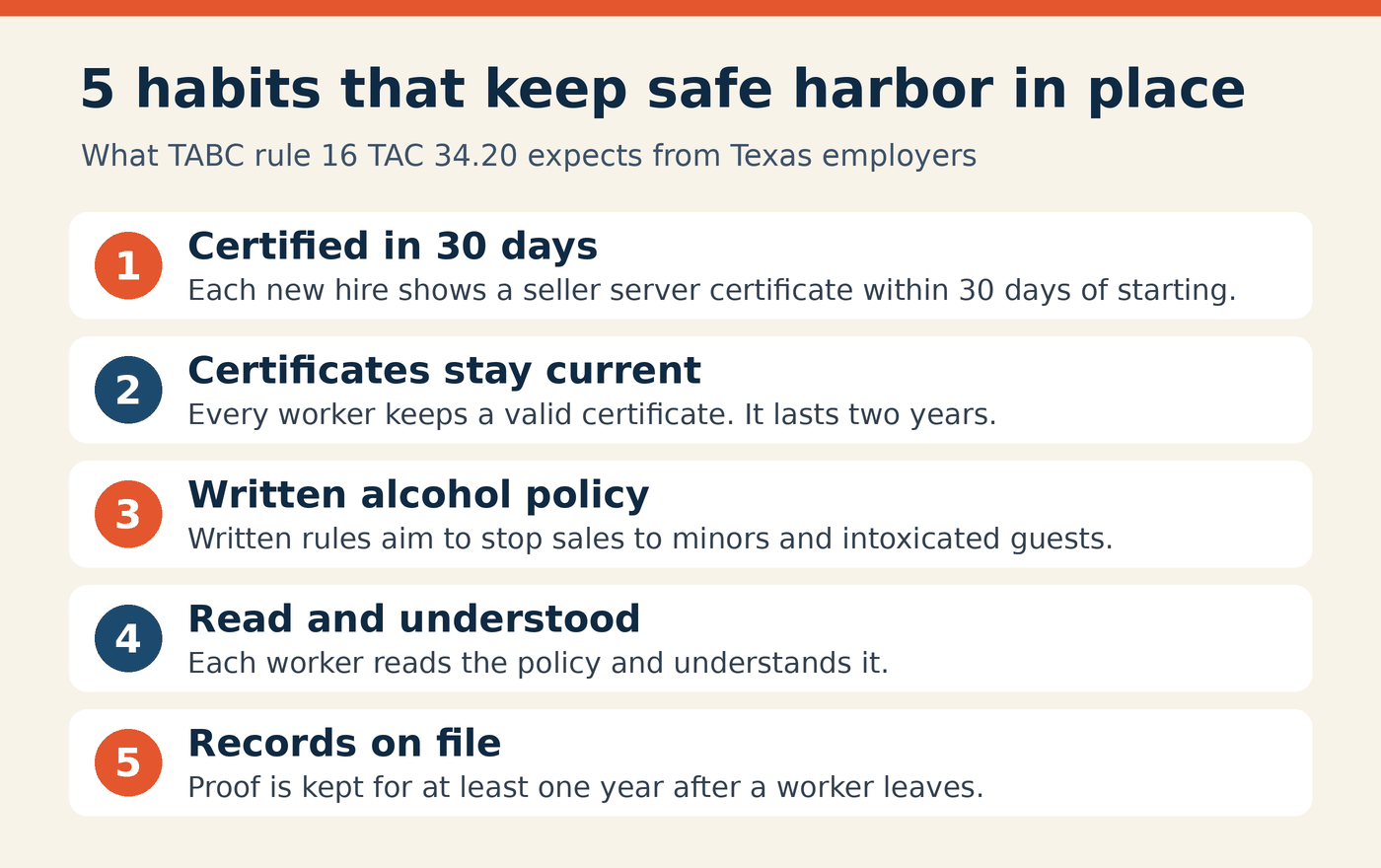
The third item on that list is the hard one. How do you show that you did not "indirectly" push a worker toward a bad sale? A TABC rule, 16 Texas Administrative Code Section 34.20, gives the answer. It sets out five standards for employers.
Miss one, and the rule presumes that you indirectly encouraged the violation. You can still argue that you did not. But now the job of proving it falls on you.
1. New hires get certified within 30 days
Each employee must show a seller server certificate within 30 days of the first day of work. The rule counts more people than you might think. "Employee" means anyone paid to sell, serve, dispense or deliver alcohol. It also means the people who directly manage or supervise that work.
2. Certificates stay current
A certificate is good for two years from the date it is issued, according to TABC's certification FAQ. Let one lapse and you have a problem. Say the worker who made the sale did not hold a valid certificate that day. The rule then says the sale counts against the license.
3. The business has written rules
You need written policies and procedures for alcohol service. They should be built to stop sales to minors, to intoxicated people, and to non-members at private clubs. They should also show that the business is firmly committed to stopping those sales.
4. Workers read and understand the rules
A policy binder that nobody opens does not help. The employer has to make sure every employee has read the policies and understood them.
5. Records are kept
Keep records that show each worker read and understood your current policies. Hold on to them for at least one year after the worker's job ends.
Repeat violations can end the protection
There is one more way to lose safe harbor. Say TABC proves three or more violations of the same type within 12 months. The rule then presumes the employer indirectly encouraged them. It does not matter if a different worker made each sale.
So a pattern of bad sales can hurt you even when every worker on the floor is certified.
What safe harbor does not cover
Safe harbor protects the license. It does not protect the person who made the sale. TABC's FAQ says that when an illegal sale is made, the seller or server "will probably be arrested." For a sale to a minor, the FAQ lists a fine of up to $4,000 and up to one year in jail.
Owners and officers are left out too. TABC's FAQ lists this as one of the tests: the person selling is not the owner or an officer of the company.
What happens after a violation
A business that wants to claim safe harbor has to act fast. Under the rule, the license holder must send TABC an affidavit, which is a sworn written statement. It says the business met the law's requirements at the time of the sale. The deadline is 10 days after the business gets the administrative notice of violation.
TABC's FAQ adds that the owner or manager must also give the names, Social Security numbers and birth dates of all employees. TABC uses that list to check that everyone was certified.
This is where good records pay off. Some managers can pull hire dates, certificates and policy records in one afternoon. They are in a much better spot than a manager who has to hunt for them.
Is certification required in Texas?
Not by state law. TABC's FAQ says there is no requirement to be certified under state law. Many employers require it anyway, and safe harbor is a big reason why.
Employers can check a worker's status with TABC's Certificate Inquiry tool. You will need the worker's name, Social Security number and birth date. TABC's FAQ says a certificate will be available 14 calendar days after the worker completes the course.
A simple routine for managers
You do not need fancy software for any of this. Ask for the certificate on day one and write down the 30-day deadline. Keep a list of expiration dates and look at it every month.
Hand each new hire the written alcohol policy, talk it through, and keep proof that they read it. Save that file for a year after the worker leaves.
Then back it up on the floor. Stand behind the server who cuts off a regular, and never tell staff to "just make the sale." The law looks at both things: the training your workers have and how you act as the employer.
This article is general information, not legal advice. If your business has received a notice from TABC, talk with a licensed attorney.